Sorry this page is a little ragged in appearance. I thought it better to get a few other pages uploaded first. There are more on my other site, but I have, as yet not brought them over.
|
|
Sorry this page is a little ragged in appearance. I thought it better to get a few other pages uploaded first. There are more on my other site, but I have, as yet not brought them over. |
|
|
|
|
|
|
|
|
|
These are just suggestions. Muscle size is a combination of diet, exercise, rest and, of course Genetics! That means some get it easier than others! |
|||||||
|
|
|||||||
|
Exercise Info Here good ref.site. |
|||||||
|
|
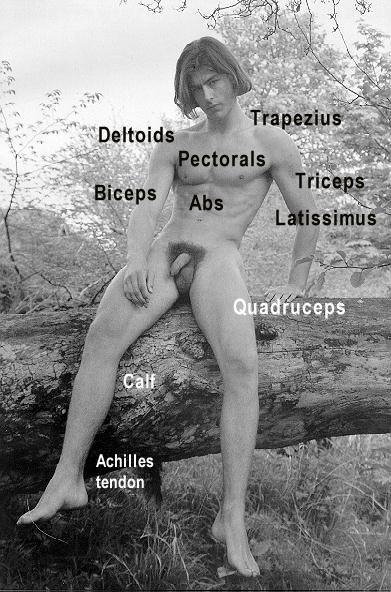
I'm using Craig here to indicate the main muscle groups. The name is on top of the muscle group or one end of it touches the group. Specific exercises "hit" a major group in each case, but others are involved too. A side effect of squats in fact is a near aerobic element too, coupled with muscle fatigue in the legs. The fatigue is an anaerobic effect as lactic acid builds up. Your comments please, should the site have a separate page for exercises for each body area? Bear in mind that some are less group specific than others. An interesting point here is do you do sets of reps with Increasing weight, or work to the limit using Decreasing weight with very short rest intervals? The "burn" with the latter on light weights will surprise you! The "pump" is very marked too! I suspect it could give better results if you are short of weights to use! |
|
|
|
||||||||||||||||||||||||
|
Midsection (Rectus Abdominus, upper and lower sections)
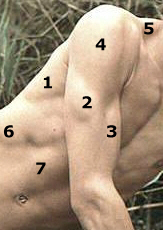
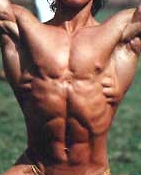
Note the mid section is liable to be the site of fat addition if you eat more food than you burn off. Oddly, running and swimming often use some of this for energy, revealing the abdominals more so than sit ups! |
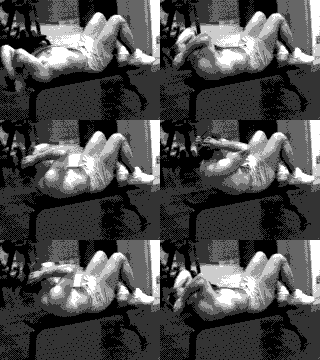
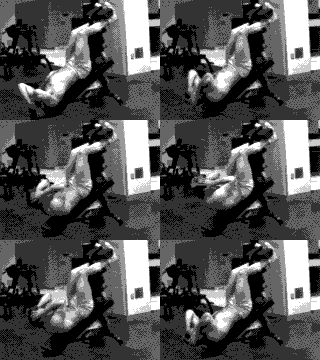
Here sit ups are most well known, but do NOT develop all the abs! The exercise should be done with BENT, not straight knees. Handiest to prepare a cushioned board with a strap to hold your feet. The end can be raised to create more resistance. Try not to settle on the board at the end of each rep, but cover a full range, keeping tension in the muscles. Crunches are done in short range though, and here the incline is a great benefit. To hit the lower abs (7), leg raises are the thing. This time your upper body shouldn't move, just raise your (straight) legs. You will really feel this one! You can also do leg raises hanging on wallbars, or on an inclined Gym bench, again to vary the resistance.
A modified full range sit-up is with arms as in the animations, do the sit up, but introduce a twist, by touching alternately the left knee with right elbow and vice versa. A pair of such being one full repetition. |
||||||||||||||||||||||||
|
Arms (Biceps, Triceps.) Wrists and forearms too)
|
Press ups as below. Also you can hit the Triceps (2) by supporting feet on a chair, hands on a bench (facing up by the way) and then do dips to 90 degrees and raise again. Watch that your back isn't hitting anything. This works surprisingly well as the ache will tell you! Also raise a bar overhead (palms front) and lower behind the head by bending the arm but keeping upper arm vertical. (This is hard, beware clouting your head at the back!) Biceps(3) Bar, EZ, "Preacher" or "Scott" curls (arms supported to force effort). Also curls with Dumbells, Standing, Seated, Single arm alternating or even inclined. All vary and focus the effort in different ways. To hit Wrist and forearm, make a wrist roller, A decent sized wood block with stout rope attatched. Slip a weight on the end and wind it up off the floor by rotating the wood block in both hands. you can also do seated mini curls with arms supported on your thighs, palms up, let a bar roll down by lowering your wrist and opening your hands but NOT let it drop. Then curl up fingers and wrist again. With Barbell curls in the free standing position, try to avoid the body swing cheat. Speed is actually a negative here, slow and steady being better. You can do short half range curls similar to the abdominal "crunch".(90 degree to shoulder level) Inclined curls with dumbells seated on a bench allow a deeper range of movement, giving a full stretch. You can also hold the dumbell horizontal or vertical, which again varies the effort subtly. |
|
Chest (Pectorals, Serratus)
|
Here the press up works with no weights. Bench pressing is the main one. Grip width is a variable. A narrow grip tends to focus more on the Triceps as well, with a wider grip more on the Pectorals. Dumbell "Flies" are very good too. The angle can be varied to "hit" different parts of the Pectorals and to bring the rest of the ribcage into action too. Warning though, a change of angle causes a big difference in the weight you need! Straight and bent arm pullovers work the ribcage to enlarge it. The Serratus Anterior come into play here, with the Latissimus involved too. The bent arm pullover exercise affects Triceps too. Incidentally with the full range straight exercise beware starting too heavy, particularly with a centre loaded "swingbell" (Just think where the weight would land!) |
||||
|
Shoulders (Deltoids, Trapezius)
|
The upright rowing exercise hits much of the shoulder area. Hold the bar, close grip at arms length, overhand grip.Raise the bar close to the body so the elbows peak above shoulder line with the bar level with your chin. To build the upper "Traps" and shoulders, use "Shrugs". The bars are held alongside or in front and you literally raise or "shrug" the shoulders. Alternate front dumbell raises (beware swinging again) hit the front deltoids. (lift to level arms not vertical is an alternative). Side raises, (again possibly to midway only) hit the side deltoids and rear to some extent. It is also possible to do this face down on a bench, raising out to the side, straight arm to level or a little above. |
|
|
|
|
|
|
|
Page Created July 25 2001 Edits May 18.2003 |