Sorry this page is a little late in appearance. I thought it better to get a few other pages uploaded first. There are more on my other site, but I have, as yet not linked them.
|
|
Sorry this page is a little late in appearance. I thought it better to get a few other pages uploaded first. There are more on my other site, but I have, as yet not linked them. |
|
|
|
|
|
|
|
|
|
These are just suggestions. Muscle size is a combination of diet, exercise, rest and, of course Genetics! That means some get it easier than others! |
|||||||
|
|
|||||||
|
Exercise Info Here good ref.site. |
|||||||
|
|
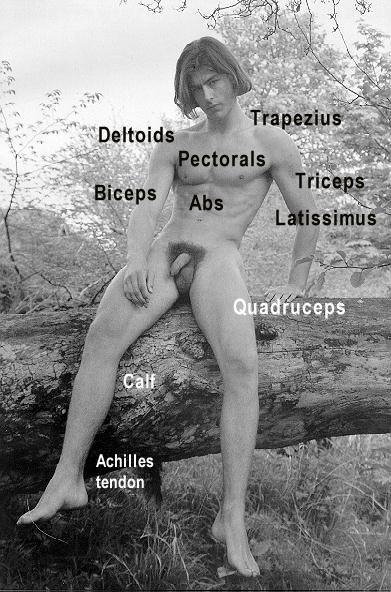
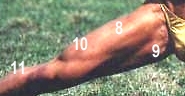
I'm using Craig here to indicate the main muscle groups. The name is on top of the muscle group or one end of it touches the group. Specific exercises "hit" a major group in each case, but others are involved too. A side effect of squats in fact is a near aerobic element too, coupled with muscle fatigue in the legs. The fatigue is an anaerobic effect as lactic acid builds up. You can see him clear of words in his own gallery here. Your comments please, should the site have a separate page for exercises for each body area? Bear in mind that some are less group specific than others. An interesting point here is do you do sets of reps with Increasing weight, or work to the limit using Decreasing weight with very short rest intervals? The "burn" with the latter on light weights will surprise you! The "pump" is very marked too! I suspect it could give better results if you are short of weights to use! |
|
Bodyparts. (upper and lower) |
Including home exercises, with or without apparatus. |
||||||||||||||||
|
For a very full exercise list, with animations click on the NBF-USA link. It's a long download but worth it! Exercises are grouped as Basic and extra ones and it is very easy to follow. I have added some animations here. |
|||||||||||||||||
|
|
|
||||||||||||||||
|
|
|
||||||||||||||||
|
Legs (Quads, Hamstrings, Calves)
|
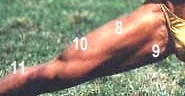
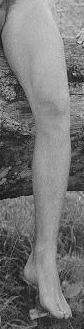
Calf (11)raises use the block again, this time toes, not heel are on it. Watch your balance here, its easy to shoot forwards if you are using weight too! There are also calf raise machines too, both standing and seated using the leverage principle. |
||||||
|
(You sit on this) (Gluteus Maximus) |
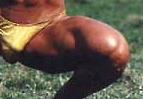
Deep Squats (*), where a spotter is essential (see the pic above) This gives full stretch, but you should avoid "bouncing" to get back up. This cancels out some of the effort. |
||||||
|
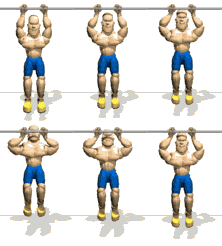
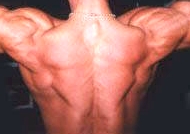
Back (Lats(1), Obliques(6), Trapezius(5), Deltoids(4).
|
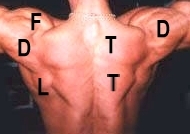
The back is a complex muscular structure, made up centrally by the Trapezius
group and at the side by the Latissimus Dorsi. The animation
shows the pull up exercise (overhand grip). Vary the spacing
of the hands to reach different strands.Underhand grip is entirely
different in effect. The Lats reach to the base of the spine
at the pelvis, the Traps roughly midway. The colour pic
clearly shows very big Trapezius group development (the centre
of the back) with the Latissimus to the sides and the lower edge of
the shot. The "fans" of the Deltoid group over each
shoulder are very impressive! |
||||||
|
Body sides. (Oblique group) |
Sidebends with a dumbell. Stand erect with the dumbell at arms length by your side. Bend slowly to that side to stretch the muscle, then reverse to the upright position, sliding the free arm down the side. Using a dumbell in each hand acts as a counterbalance and cancels too much effort.Then swap sides. This group tends to thicken with fat cover as you age. |
||||
|
Shoulders (Deltoids, Trapezius)
|
The upright rowing exercise hits much of the shoulder area. Hold the bar, close grip at arms length, overhand grip.Raise the bar close to the body so the elbows peak above shoulder line with the bar level with your chin. |
|
Basic Diet |
Clearly the bigger you get, the more you need to eat to maintain your form. However if you STOP working out, eat less, or you will gain fat as well. Not change into fat, but add it as well. The ratio of protein needed is g per kg of bodyweight. This assumes you are using energy in training incidentally. Carbs and fat are used as energy if you are exercising, but can cause fat to build up if you are not! |
|
|
|
|
|
|
|
Page Created July 25 2001 Edits May 18. 2003 |